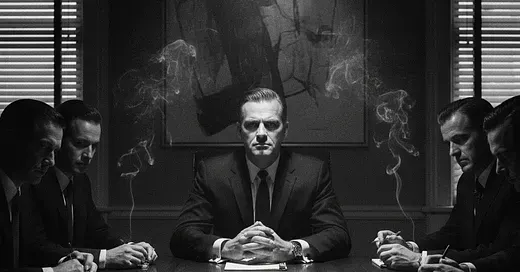
That phrase rarely arrives with a shout. It comes quietly, calmly, often with a faint, patronizing smile. It is uttered by a leader leaning back in their chair after listening to a proposal, an analysis, or a warning from their team. And the moment it echoes through the room, it creates an energy vacuum. It is the sound of a mind sealing itself shut. The sound of the impenetrable armor of ego descending. It is the quiet, final thud of a shovel burying a newborn idea. And there is no market storm, no competitive threat, no economic crisis that has destroyed more value, potential, and future than those four, seemingly simple words: “I know better.”
This phrase is the ultimate manifestation of a cognitive bias known as the Dunning-Kruger effect(4). It’s a paradox in which a lack of knowledge in a particular area creates an illusion of superiority, while true experts are often filled with self-doubt. A leader who has achieved past success, guided by one set of rules and circumstances, becomes the most vulnerable. Their past victories become exhibits for their ego, confirmation that they possess the formula. They stop learning because they are convinced they have already learned everything they need to know. Any new proposal that doesn’t fit into their winning formula is perceived not as an opportunity, but as an anomaly, a flaw in someone else’s thinking.
When a team member, after weeks of research and analysis, presents an idea that challenges the status quo, the leader trapped in the illusion of infallibility doesn’t hear the content. They hear a threat. They don’t hear arguments; they hear an implicit message: “The way we’ve been doing things might not be the best way anymore.” For an ego fused with its position, this is tantamount to a personal insult. The reaction, “I know better,” is not an intellectual response; it’s a defense mechanism. It’s a way to protect the self-image of being the smartest person in the room, even at the cost of destroying a valuable innovation.
The consequences of this phrase are devastating and immediate. The person who made the proposal feels humiliated and devalued. Their effort has been dismissed without a real discussion. The rest of the team receives a clear message: it doesn’t pay to think. It doesn’t pay to take risks. Safety lies in executing, not proposing. Creative and proactive minds begin to shut down. One by one, they stop bringing their best ideas to work and start bringing only themselves, as mere executors of tasks. The leader, in their delusion, sees this as a victory. The team is finally “aligned.” In reality, they have just transformed their team of thinkers into an army of yes-men. They have amputated the organization’s collective brain, leaving only their own. And no single mind, no matter how brilliant, can see every angle and recognize every threat.
The most illustrative and tragic monument to this phrase is the tombstone of the Blockbuster corporation. The year is 2000. Into the headquarters of Blockbuster, the undisputed giant of the movie rental world, walk the two founders of a small, relatively unknown startup called Netflix. Their business model is odd, mailing DVDs, with no late fees. Their proposal is radical: they offer to be acquired by Blockbuster for $50 million. They propose a partnership where Netflix would run Blockbuster’s online business, merging the power of the brand with a vision for the future.
Blockbuster’s CEO, John Antioco, and his team, according to Netflix co-founder Marc Randolph, barely gave them the time of day. Antioco, the man who ran an empire of 9,000 stores and tens of thousands of employees, looked at this proposal and saw a curiosity, a “small niche business.” He knew how the entertainment industry worked. He knew that people wanted to pick up a movie instantly, that the experience of going to the video store was part of the ritual. He knew better. He rejected the offer, almost laughing them out of the room.
The rest is history. That phrase, whether spoken or just silently demonstrated in a Dallas boardroom, didn’t cost Blockbuster $50 million. It cost them their existence. Ten years later, in 2010, Blockbuster filed for bankruptcy. At that moment, Netflix was worth billions. Antioco was not a stupid man. He was a victim of his own success. His mind was so convinced of the rightness of the existing model that he couldn’t even imagine a world in which that model became irrelevant. His “I know better” was the anchor that held him firmly to the bottom as the tide of the future swept everything away.
Every time a leader says, “I know better,” they are not just closing one door to one idea. They are laying the foundation for their own ruin. They are choosing the comfort of the known over the potential of the unknown. They are sacrificing the company’s future on the altar of their ego.
That is why this phrase is not a statement of confidence. It is an epitaph. The epitaph on the grave of an innovation that could have been. The epitaph on the grave of a team that could have been great.
And, ultimately, the epitaph on the grave of a company that refused to see the future because its leader was too in love with the reflection of his own past.
_____________________________________________
CASE STUDY
Let’s bring the story of Alen Hadžić, our Chief Commercial Officer, back to life. We saw how the corner office built him a suit of armor. Now we will witness the moment that armor becomes a weapon, when a single phrase turns into an anchor that pulls the whole ship down.
This is the continuation of his story.
Case Study: The Crash of “Titan” and the Three-Word, Million-Dollar Sentence
After “Titan” was approved, Maja, the analyst who had dared to question it, knew she was walking on thin ice. But she was a professional, a stubborn soldier for the truth. Instead of backing down, she did what she did best: she dug deeper into the data. She spent the next three months in the quiet of her department, building what she internally called “Project Cassandra”, a detailed simulation model designed to predict, with terrifying accuracy, the consequences of “Titan’s” implementation.
Her analysis was a masterpiece. Using historical customer data, predictive modeling, and social media sentiment analysis, she constructed an alternative future. A future in which Alen’s vision led not to growth, but to a mass exodus of the most profitable, long-term clients, the very ones the new, aggressive strategy offended the most. Her conclusion was brutal: “Titan” wouldn’t just underperform; it would do active, measurable damage to the brand, costing the company more than ten million euros in lost revenue in the first two years.
With trepidation but also a sense of duty, she scheduled a meeting with Alen. This time, she asked for just fifteen minutes of his time to present “some new data.” She walked into his office on the twelfth floor. The air was different up here, thinner. Alen sat in his massive chair, not like her former colleague, but like a king holding an audience.
Maja was calm, precise. She presented her analysis, slide by slide, letting the numbers speak for themselves. She wasn’t giving an opinion; she was presenting a mathematical certainty. As she spoke, she watched Alen. His expression never changed. He didn’t ask questions. He didn’t take notes. He just sat there, his fingers drumming lightly on the desk. He wasn’t listening to understand; he was listening to pass judgment.
When she finished, a silence fell over the room. Maja felt her heart tighten. She waited.
Alen leaned forward slightly. He glanced first at the large window behind him, as if admiring his empire, then turned his gaze back to her. His smile was faint, almost fatherly. And then he uttered the four words. He didn’t shout. He said them calmly, almost with pity.
“Maja, I know better.”
His entire metamorphosis was captured in those four words. It wasn’t an argument. It wasn’t a counter-statistic. It was a wall. The impenetrable armor of ego. It was a message: “I got to the twelfth floor by not listening to pessimists. I have the formula. Your numbers are just noise. My gut feeling, the intuition of the CCO, is the truth.” He didn’t see her analysis as a gift, as a chance to avert a catastrophe. He saw it as a threat. As an implicit message that he, Alen, might be wrong. And an armored ego cannot tolerate that possibility. His past success had become the foundation for his delusion of infallibility. He was a victim of his own success.
Maja felt the ground give way beneath her. Her effort, her logic, her truth, all of it obliterated by a single, arrogant sentence. She packed up her laptop. She nodded. And she walked out. As she walked down the hall, she wasn’t angry. She was defeated. And her team, who was waiting for her, saw it all in her eyes. The message was clear: it doesn’t pay to think. From that day on, the analytics department at “OmniCorp” stopped producing insights. They started producing reports that confirmed what management wanted to hear. The creative and proactive minds began to shut down. Alen had gotten his “aligned” team. In fact, he had amputated the organization’s collective brain, leaving only his own.
Nine months later, Maja’s “Project Cassandra” proved to be prophetic, almost to the euro. The loss of loyal clients was massive. Revenues collapsed. At a crisis meeting, when faced with red numbers that were eerily similar to those in Maja’s presentation, Alen didn’t mention her warning. He spoke of an “unexpected market reaction” and “aggressive moves by the competition.”
By then, Maja was no longer at “OmniCorp.” She had left two months prior. The competitor that hired her not only gained a top-tier analyst but also detailed insight into all of “Titan’s” weaknesses, allowing them to launch their own superior strategy and capture even more market share.
Alen’s four-word sentence didn’t just cost “OmniCorp” Maja. It cost them millions in lost revenue. It cost them their market position. It cost them their culture of learning and innovation. That single, quiet, arrogant sentence was the epitaph on the grave of a team that could have been great and a strategy that could have been saved. It was the anchor, and he, a captain too in love with the sound of his own voice, didn’t even notice his ship was sinking. He had proven that he “knew better.” The price of that knowledge was ruin.
(4) — Kruger, J., & Dunning, D. (1999). Unskilled and unaware of it: How difficulties in recognizing one’s own incompetence lead to inflated self-assessments. Journal of Personality and Social Psychology, 77(6), 1121–1134. (This is the seminal academic paper in which social psychologists Justin Kruger and David Dunning first described the effect.)
____________________________________________________
from the book:
“The Silent Edge: The Hidden Psychology of Business Success”
(For those who know the most important things in business are never said)
Author: DŽERALD LETIĆ
Sarajevo, 2025