Excerpt from the book: “Priceless: The Hidden Psychology of Price” (On True Value and What We Are Truly Willing to Pay). Letić, Dž. (2025). Repubblica Media Sarajevo.
(9 min read)
Do not view this as an assignment. View it as the most important strategic meeting you will ever have, a meeting with yourself. This is where we carve the foundation of your business. The purpose of this guide is to ask you the right questions, the ones that will force you to find the answers within yourself and within the world of your ideal client. So, take a pen and paper. But more importantly, take a mirror and take your time. Your price is a reflection of what you see in that mirror. Let’s begin.

Phase One: Internal Archaeology — Digging for Your “Why”
Before you can ask what something is worth to others, you must know, without a shred of doubt, what it is worth to you. Here, we detach from the market, from the competition, from the noise. We look inward. Answer these questions with brutal honesty.
The Origin Question: Why does this thing you do even exist? I don’t mean the business plan. I mean the true, human why. What problem in the world frustrated you so much, what itch did you have to scratch, that you were compelled to create this? Tell that story. This is the beginning of your myth, the foundation of your value.
The Sacrifice Question: What have you, your team, your family, invested in this? I don’t just mean money. Measure it in sleepless nights. Measure it in the risk you took while others chose safety. Measure it in the thousands of hours of learning, trying, and failing. Measure it in patience and dedication. The price you set must honor that sacrifice. If it doesn’t, you have just devalued it yourself.
The Conviction Question (The Mirror Test): Now, having acknowledged the sacrifice and the story, ask yourself the ultimate question. If you were the ideal client, with the problem you solve and the money in your pocket… would you, with full knowledge of every detail, every drop of sweat, and every nuance of the vision, pay the price you are considering? Without hesitation. With the feeling of having made a smart move. If the answer is an immediate and resounding “Yes!”, you are on the right track. If you feel even the slightest hesitation, that is where your internal insecurity lies. And until you resolve it, the market will smell it from a mile away.
Phase Two: Empathy Mapping — Charting Your Client’s Soul
Now we turn the telescope around. Forget about yourself for a moment. Your job is no longer to look inward, but to see through the eyes of your client, that ideal client you would gladly serve for the rest of your life.
Define the Hero: Who is your hero? Not demographically (woman, 35–45…), but psychographically. What are their deepest aspirations? What wakes them up in a cold sweat at three in the morning? What do they want to achieve but fear they cannot do alone? You must know more about them than their own spouse does.
Name the Dragon: What is the precise, painful name of the dragon your hero is fighting? It isn’t “bad marketing” or “inefficiency.” It is “the fear that my business will fail,” “the feeling of being invisible in the market,” “the exhaustion of constantly putting out fires.” Give that dragon a name. Describe the pain it inflicts. Calculate, if you can, the cost of that pain, the cost of inaction, in money, time, and peace of mind.
Picture the Promised Land: Describe the “day after.” What does your hero’s life or business look like after your magic sword has done its job? How do they feel? They didn’t get software; they got their time back. She didn’t get a dress; she got self-confidence. You aren’t selling the outcome. You are selling the feeling of that outcome. Write down that feeling. It is your most valuable asset.
Phase Three: Value Engineering — Architecting Your Offer
Now we merge the internal truth and the external empathy into a concrete, tangible offer. This is where you stop being a poet and start being an engineer.
Translate Features into Benefits: Take a list of all the features of your product or service. And next to each one, ask the “So what?” question. And keep answering until you get to a deep, emotional benefit for the client. “Our coat is made of cashmere” (SO WHAT?) -> “It’s incredibly soft” (SO WHAT?) -> “You will feel comfortable and luxurious all day long.”
Design Your Tiers (if applicable): If you have multiple packages, draw them out. Give them names that reflect an identity, not just a level (”Starter,” “Professional,” “Visionary”). Define precisely: What is the purpose of your “Basic” package as an entry point? Where exactly does it hurt to stay on it? What is the unique value of your “Pro” package that you want most people to buy? How does your “Premium” package function as an anchor that makes “Pro” look like the best deal? Be ruthless in your clarity.
Phase Four: The Alchemy of Communication — Creating the Story Around the Price
The value has been created. Now it is time to communicate it. Prepare your script.
The Value Phrase: Summarize the entire value you offer in a single, powerful sentence. Not “We sell X.” But “We help Y (your hero) achieve Z (the promised land).” This is your mantra.
Price Framing: How will you present your price? Will you break it down into smaller, daily or monthly amounts? What will you compare it to? Write down those exact sentences. Prepare them. They are your most important arguments.
The Objection Script: Imagine a client tells you, “It’s too expensive.” What will you say? Write down your response, following the model from the previous chapters: The Embrace (”Thank you for your honesty…”), then The Diagnosis (”Is the issue the budget, or the value…?”). Practice it until it becomes second nature.
Phase Five: The Final Verdict — The Pride Test
Now, at the end, return to the very beginning. Before you is your story, your client, your offer, and your price. It is all there. Ask the final question. Not “Is this correct?” or “Will this work?” But:
“Am I proud of this?”
Look at the figure you have set. Does it honor everything you have invested, everything you know, and all the transformation you promise? When you say it out loud, do you feel firmness in your voice and peace in your soul? Is this a price you would proudly declare to the world, knowing it is a fair statement of the value you bring?
If the answer is yes, then you are ready. You are armed. With conviction. And in the game of price psychology, conviction is the only weapon you will ever need. Now go and tell your story.
The Tale of Clara’s Secret Notebook
An Excerpt from the Diary of Clara Dubois, Paris, Autumn 1931.
I haven’t slept in nights. I sit at my father’s old desk, and before me is only this notebook and an emptiness. Jean-Luc was clear. “The world is changing, Clara. Your heritage is beautiful, but it belongs to the past. You must create something… your own.”
But what? And more importantly, at what price? I feel like an impostor. I feel afraid. So, tonight, I will not blend scents. I will try to blend thoughts. I will follow the map that Jean-Luc sketched for me on a café napkin…
Phase One: Internal Archaeology
“Forget the market,” he said. “First, dig within yourself.”
The Origin Question: Why am I doing this? The answer I give to customers is the story of my father, of the legacy. But that is only half the truth. The real, naked truth is… I felt trapped. My entire life. Trapped in my father’s laboratory, in his formulas, in his vision of the world which was so different from my own. My “why” is not just to preserve his legacy. My “why” is to break free from it. To create something that is at once both him and me. A bridge between his discipline and my rebellion. My brand… my brand exists to prove that these two things can coexist in perfect, tense harmony.
The Sacrifice Question: What have I invested? My entire being. I invested years in learning a chemistry I hated, just to please him. I invested my youth in this dusty shop while my friends danced in jazz clubs. And now? Now I am investing everything I have, money, reputation, the last atom of my courage, in an idea that could fail. If I fail, I will have betrayed both him and myself.
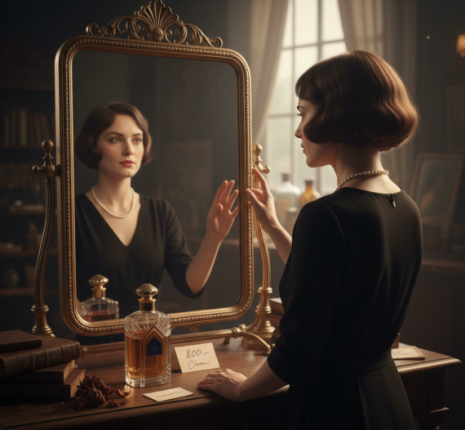
The Conviction Question (The Mirror Test): If I were her… the woman I keep seeing… the one with the garçonne haircut, confident, who reads Joyce and paints, but also respects history… would I pay a fortune for a scent that captures this duality? Yes. Absolutely. I would not blink. Because it wouldn’t be a perfume. It would be… a validation. It would be proof that I am not alone.
Phase Two: Empathy Mapping
“Now forget yourself,” whispers Jean-Luc’s voice in my head. “Become her.”
Define the Hero: My heroine is not just a “modern woman.” Her name is Juliette. She is an artist. By day, she visits the Louvre and admires the works of Ingres. By night, she descends into the smoky cellars of Saint-Germain, where American musicians play a music that has no rules. She is torn. She loves the beauty of the past, but she craves the freedom of the future. Her greatest aspiration is to reconcile these two halves of her soul. Her greatest fear is that by choosing one, she will forever betray the other.
Name the Dragon: Juliette’s dragon is the tyranny of choice. The world tells her: you must be either traditional or modern. A lady or a rebel. Your father or your mother. And this pressure is suffocating her. The cost of this inaction, this indecision, is the feeling of living an inauthentic life, of playing a role that is not entirely her own. It is a quiet suffering.
Picture the Promised Land: The “day after”… It is the moment Juliette stands before the mirror. She is wearing a simple, black Chanel dress. But around her neck, she wears her grandmother’s pearl necklace. And on her skin… on her skin, she wears “Contraste.” And in that moment, she realizes: she doesn’t have to choose. She can be both. She is the bridge. The feeling she gets is not confidence. It is completeness. A feeling of peace. Of permission to be perfectly, beautifully imperfect.
Phases Three & Four: Engineering and Alchemy
It is time to translate the dream into matter.
Features -> Benefits:
Traditional base (rose, sandalwood) -> (SO WHAT?) -> The scent exudes timeless elegance -> (SO WHAT?) -> You will feel grounded and secure, connected to something enduring.
Modern, synthetic note (ozone, aldehydes) -> (SO WHAT?) -> The scent has an unexpected, sharp freshness -> (SO WHAT?) -> You will feel bold, intriguing, like a woman a step ahead of her time.
The fusion of the two -> That is “Contraste” -> The feeling of Completeness.
On the counter, there will not be just one option. I will create three:
- “L’Esquisse” (The Sketch): A small bottle with only the traditional base. Price: 250 francs. (The antechamber).
- “L’Avant-Garde”: A small bottle with only the modern, synthetic note. Price: 250 francs. (The other antechamber). The pain point: both are incomplete, one-sided.
- “Le Contraste Parfait”: The full, large Art Deco bottle, the perfect synthesis. Marked as “Signature de Clara Dubois.” Price: 800 francs. (The obvious winner, the solution to the dilemma).
My Value Phrase will not be “The new perfume by Clara Dubois.” It will be: “For the woman who refuses to choose between the past and the future.”
And my Objection Script: If they say, “800 francs is too expensive,” I will say, “I understand. But, what is the value of the permission to be all that you are, without compromise? This perfume is not just a scent. It is your personal manifesto.”
Phase Five: The Final Verdict
Here it is. It stands before me. The entire story, all my struggle, and all of Juliette’s dreams, distilled into a single, crystal bottle. I look at it. And at the price I have written beside it. 800 francs. The figure is still frightening. But now… I feel something else.
I ask myself the final question: “Am I proud of this?”
Yes. Deeply, truly proud. Because this figure does not represent the cost of the ingredients. It represents the price of reconciliation. The price of the freedom to be complex. And yes. I will state it without a tremor. Because I am not just selling a perfume. I am selling permission. And permission… is priceless.
I sign my name below,
Clara.
It is done. No, it is just beginning.