The average guarantee is just as useless as the average contract. It is riddled with fine print, exclusions, and limitations. “We guarantee a money-back refund within 30 days, provided the product is unopened, returned in its original packaging, and provided a meteor hasn’t struck your warehouse…” Such a guarantee is an insult. It communicates fear, rather than confidence.
The “Outrageous” Guarantee of the Lighthouse Methodology is something else entirely. It is your Manifesto of Confidence translated into a commercial promise. It is simple, unconditional, and so powerful that it triggers an initial shock in the client, followed by a profound sense of relief. It is designed not to be used frequently, but for its very existence to completely eliminate the perceived risk of purchase. It must be so strong that it sounds almost unbusinesslike, almost irrational. Because its power lies precisely in that irrationality.
The Anatomy of an “Outrageous” Guarantee:
To be “outrageous,” a guarantee must meet three criteria: it must be unconditional, specific in its promise, and greater than the initial investment.
- Unconditionality (No Fine Print): Your guarantee must not have “ifs” or “buts.” It must be absolute. It is a promise that you stand behind your solution, period.
- Example of a poor guarantee: “We guarantee you will be satisfied, provided you meet all implementation requirements.”
- Example of an outrageous guarantee: “Mr. Sterling, our pledge to you is simple. If at any point in the first six months, for any reason whatsoever, you feel this partnership hasn’t delivered the value we promised, just let us know. We won’t ask why. We won’t demand proof.”
- By doing this, you’ve removed all mental effort from the client. They don’t have to “qualify” for the guarantee. Their feeling alone is enough. In doing so, you are showing them ultimate trust.
- Specificity of the Promise (Connected to the Pain): The guarantee must not be generic (a “satisfaction guarantee”). It must be directly tied to the Dragon you’ve identified together and the Promised Land you’ve painted.
- Example of a poor guarantee: “We guarantee a money-back refund.”
- Example of an outrageous guarantee: “Our pledge is that we will slay the ‘Paperwork Quagmire’ together. If after 90 days the ‘Paperwork Quagmire’ is still alive, if your team is still wasting time on administration instead of creation…”
- With this, you’ve reminded the client of the stakes, the true purpose of this investment. The guarantee isn’t just financial; it’s mission-critical. It guarantees the outcome, not just the product’s functionality.
- The Pain Factor for You (More than 100% Refund): This is the element that makes the guarantee “outrageous” and completely flips the risk equation. The guarantee must cost you more than it costs them. It must demonstrate that your risk in this transaction is greater than theirs.
- Example of a standard guarantee: “…we will return your full investment.” (Risk is neutral, 0:0).
- Example of an outrageous guarantee: “…not only will we refund your full investment of $10,000, but we will pay you an additional $2,000 for your lost time and effort. And you, of course, get to keep all the software and everything we’ve done up to that point. All the risk is strictly on us.”
The Psychology Behind the “Outrageous” Guarantee:
The moment you present an offer like this, a series of powerful conclusions are drawn in the client’s mind:
- “They must be incredibly confident in their product.” No one in their right mind would offer something like this if their product wasn’t top-tier. Your guarantee becomes the strongest possible signal of quality (FN1). Paradoxically, the stronger the guarantee, the less likely it is that anyone will ever use it.
- “They truly believe in a partnership, not just a transaction.” Your willingness to pay for their “lost time” shows that you value their effort as much as your own money. It is a supreme act of respect.
- “My risk is now negative.” Not only can they lose nothing, but in the worst-case scenario, they might even come out ahead. The fear of making the wrong decision is completely eliminated. Only the hope for success remains. The buying decision stops being difficult. It becomes easy, almost obvious.
When and how to present it?
An “outrageous” guarantee is not how you start a conversation. It is your “ace up your sleeve,” your crowning weapon brought out in the final stage of the decision-making process as an answer to those last, unspoken doubts. After you’ve gone through all the options and they show signs of hesitation, you say with total composure:
“James, I understand that this is still a major decision, and I sense there might still be a shred of doubt. Let me remove it for you completely. I don’t want this to be a contract between us; I want it to be a pledge. And our pledge to you is…”
And then, slowly and with full conviction, you lay out your “outrageous” guarantee. And after you lay it out, just as you did after stating the price, you pause. You let the weight and the sheer “absurdity” of your confidence sink in. In that silence, they won’t be thinking about how to exploit you. They will be thinking only one thing: “This is the partner I’ve been looking for all along.” With that, you haven’t just brought the ship into the Harbor; you’ve dropped the anchor so deep and so firm that no storm can ever move it.
The Vow of the Pisani Shipyard
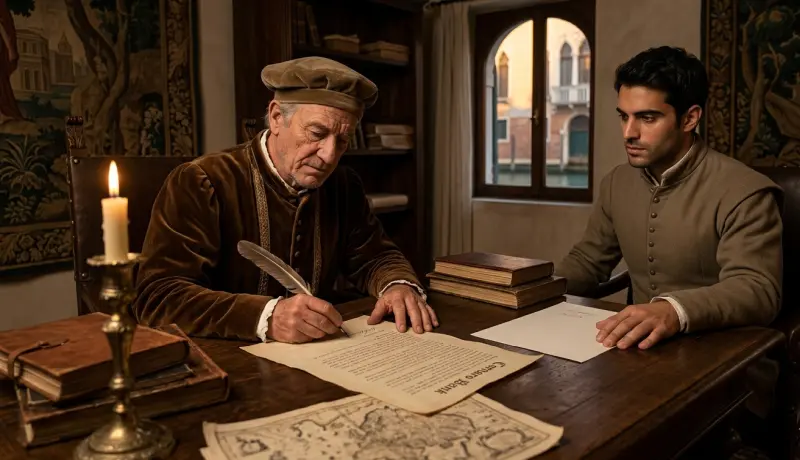
Everything was in place. The contract with the Cornaro Bank had been finalized. The guild leaders from the Arsenal (FN2) had given their blessing. Vettor Pisani held his quill over the parchment that signaled the beginning of his lineage’s salvation. But his hand was trembling.
Matteo, sitting across from him in the silence of Pisani’s office, sensed that final vibration of fear. He knew that no rational arguments could help anymore. The heart had said yes, the brain had said yes, but the ancient, reptilian part of Pisani’s being was still screaming: Danger! Risk! The Unknown!
This was the moment Leonardo Foscarini used to call the “breaking point.” The moment where trust is either shattered or forged into unbreakable steel.
Matteo did not lean forward. He did not begin repeating old arguments. Instead, he leaned back slightly, creating space. He covered Pisani’s contract with his hand, bringing him to a halt.
“Vettore,” he said softly, yet with a strength that filled the room. “Do not sign just yet.”
Pisani looked at him, confused and apprehensive.
“This parchment before you,” Matteo continued, “is merely a contract. Ink on paper. It exists to protect bankers and lawyers. But it does not protect what matters most, it does not protect your dream. Therefore, before you put your name to it, I want to give you my vow. Not as a merchant, but as a partner.”
Matteo took a clean sheet of paper.
“Our guarantee is, as you know, absolute. If the ship is not built to the highest standards, I personally cover every loss. But that is the easy part. That is just money.” His gaze deepened. “My vow to you is different. The Vow of the Pisani Shipyard.“
“I vow that our shared objective is not only to launch ‘La Furia,’ but also to make your shipyard profitable again within two years. To slay the Dragon we have named the ‘Shadow of Oblivion’.”
(Specificity of the Promise Linked to Pain)
“And if, after those two years,” he continued, his voice unwavering, “you, Vettor Pisani, look into your ledgers and into your soul and feel that this partnership has not restored pride and profit to your House… I will not only return every ducat that you or the bank have invested. I will go a step further. I will personally, from my own pocket, pay the first salary of every one of your workers for the following six months, as my penalty for having wasted two years of your life. All risk, from this moment on, is no longer yours. It is mine.”
(Personal Cost and Unconditionality)
A heavy silence fell over the room. Vettor Pisani looked at Matteo as if seeing him for the first time. The fear in his eyes was fading, replaced by disbelief, and then by a deep, immense respect. The offer was absurd. Insane. No merchant in the history of Venice had ever offered such a thing. It was business suicide, unless…
Unless the man making such a vow was absolutely, maniacally certain he would succeed.
Matteo wasn’t selling a plan. He wasn’t selling a guarantee. He was manifesting absolute confidence. He was saying: “I believe in this so strongly that I am willing to stake the future of my own House on it.” His vow was not a safety net under the tightrope. It was a declaration that he could fly.
“Your risk is now negative, Vettore,” Matteo concluded. “In the worst-case scenario, you get your money back and your men are paid. And in the best… you reclaim your legacy. I do not see how you can lose.”
And then he fell silent. He allowed the weight and the sheer audacity of his vow to settle in Pisani’s heart.
Vettor Pisani slowly, as if in a trance, took up his quill. His hand no longer trembled. He dipped the nib into the ink and, with a firm, decisive stroke, signed the Cornaro Bank contract. Then he pushed that contract aside. He took Matteo’s blank sheet of paper, the one that held nothing but the vow, and signed his name beneath the non-existent text.
He looked at Matteo. “This is the contract that holds value for me.”
Doubt was gone. Fear was gone. Regret was gone. There was only a partnership forged in the boldest vow Venice had ever heard. Vettor Pisani’s ship did not merely sail into the harbor. In that harbor, it was met by another lighthouse, one that guaranteed, by its own light, that the darkness would be overcome.
This is a part of my book “The Lighthouse Methodology”
This book is part of the Business Psychology Series – a complete system that explores how people think, decide, and act in business.
(FN1) – Spence, A. M. (1973). Job Market Signaling. The Quarterly Journal of Economics, 87(3), 355–374. Retrieved from https://doi.org/10.2307/1882010 (Michael Spence was awarded the Nobel Prize for his work on “signaling theory.” The author explains that in situations involving asymmetric information, where one party, such as the seller, possesses more knowledge about a product’s quality than the other, the informed party must send a credible signal to convey that information. For a signal to be credible, it must be “costly” or risky for the sender. An “insane” guarantee is a prime example of such a signal. Its potential “pain” for the seller is exactly what makes it a credible testament to their confidence in the product’s quality, directly supporting the assertion made in the text.)
(FN2) – The Arsenal: The Venetian Arsenal (Arsenale di Venezia) was a state-owned complex of shipyards and armories. It was the heart of the Venetian Republic’s naval power and is considered one of the earliest examples of a large-scale industrial enterprise in history.